
From Holon to Sysoma
A Letter on Convergence

"Let everything happen to you: beauty and terror. Just keep going." – Rumi
Hi friends,
Almost two years ago, I introduced many of you to the Holon Institute, a nonprofit advisory grounded in the conviction that to change our systems, we must change our stories. We organized our work around five words: emergent possibility through embodied imagination. We asked what it means to live in right relationship with soul, soil, and society. People I love poured their time and belief into it. Some of you reading this were among them.
Then 2025 happened.
We launched the Holon Institute into what may have been the worst year on record to launch a nonprofit. As the Trump administration gutted social funding, philanthropy responded with hardcore austerity. Foundations froze. Program officers went quiet. Conversations that had felt promising trailed off, and the capital that might have supported a young institute asking civilizational questions simply was not there.
Despite these challenges, we partnered with the House of Beautiful Business and the Acosta Institute to co-host a global series of gatherings we called The PolyOpportunity. Across four events on three continents, we welcomed thousands of people united by a shared conviction: that in the death of old systems, the birth of new ones becomes possible. Participants left each gathering inspired, connected, and equipped to live as medicine in their own contexts and communities.
That success, however, did not solve our funding challenges. So we spent several months in contemplation, seeking a viable path forward. From the beginning, we knew we did not want to monetize the Holon Institute. We were intentional about building something accessible to all, completely untethered from the incentives of capitalism. Without philanthropic funding, that meant each of us had to find other ways to support ourselves and our families.
This became a season of deep reflection for me. I wrestled with heavy questions of purpose and the frustration of an uncertain future. So I wiped the slate clean and looked back at the experiences, relationships, and ideas that had been pivotal in my life. As I mapped that journey, a pattern emerged – I have always been drawn to the craft of placemaking. From working in my dad’s cabinet shop as a kid to leading multi-stakeholder urban master planning initiatives at some of the world’s largest architecture firms; shaping the built environment has shaped me.
And then it occurred to me: everything the Holon Institute was founded to address converges in the built environment.
The metacrisis we spent our time naming, the loneliness, the ecological unraveling, the wealth chasm, the cultural flattening, the erosion of belonging. These systemic challenges are not abstract. They are literally poured in concrete. The subdivision is a story about what a good life is. The strip mall is a story about what a community owes itself. The redlined neighborhood is a story about whose voices matter.
The built environment is where soul, soil, and society stop being a framework and become an address. It shapes how we move and who we encounter. It determines whether children walk to school or are driven past strangers. Whether elders are woven into daily life or warehoused at its edges. Whether water soaks into living ground or sheets off pavement into a degraded stream. Whether wealth accumulates in a community or is extracted from it on a three year hold.
Holon’s thesis was that all new systems are predicated on new stories. I still believe that with my whole being. What I came to see is that the built environment is where new stories become new systems. It is the medium through which a different narrative about land, capital, and community stops being aspiration and becomes infrastructure. Becomes someone’s front porch. Becomes the reason neighbors know each other’s names.
In my recent essay, How Change Actually Happens, I argued that transformation begins inside us and expands outward, first relationally, then organizationally, then systemically. What I didn’t say there is that the built environment is where that sequence completes itself and takes form. A home holds a person. A street holds homes. A neighborhood holds streets, and a watershed holds them all. Place is holonic in the truest sense, each whole nested within a larger whole. Which means a developer is not working at one level of the change sequence. A developer is working at every level at once, shaping the container in which the personal, the relational, and the systemic either flourish or fragment together.
In this way, I began to see the mission of Holon finding its medium.
So in the fall of 2025, I founded Sysoma. The name means systems of life. Integrated living systems in which the social, ecological, economic, and cultural are understood as one whole. It is a regenerative placemaking and development studio built on the conviction that how we build determines how we live, and how we live will determine whether we endure.
Where conventional development asks what a piece of land can produce for investors, we ask a different question: what does this place need to become more alive, more resilient, more generative over time? That question changes what gets drawn, financed, and built. It means designing with hydrology rather than against it. It means returning to the walkable, intergenerational forms humans have always gravitated toward when given the choice. It means aligning capital with the long arc rather than the quick extraction. And it means taking beauty seriously, because places that tell people their lives matter are not decoration. They are how culture stays alive.
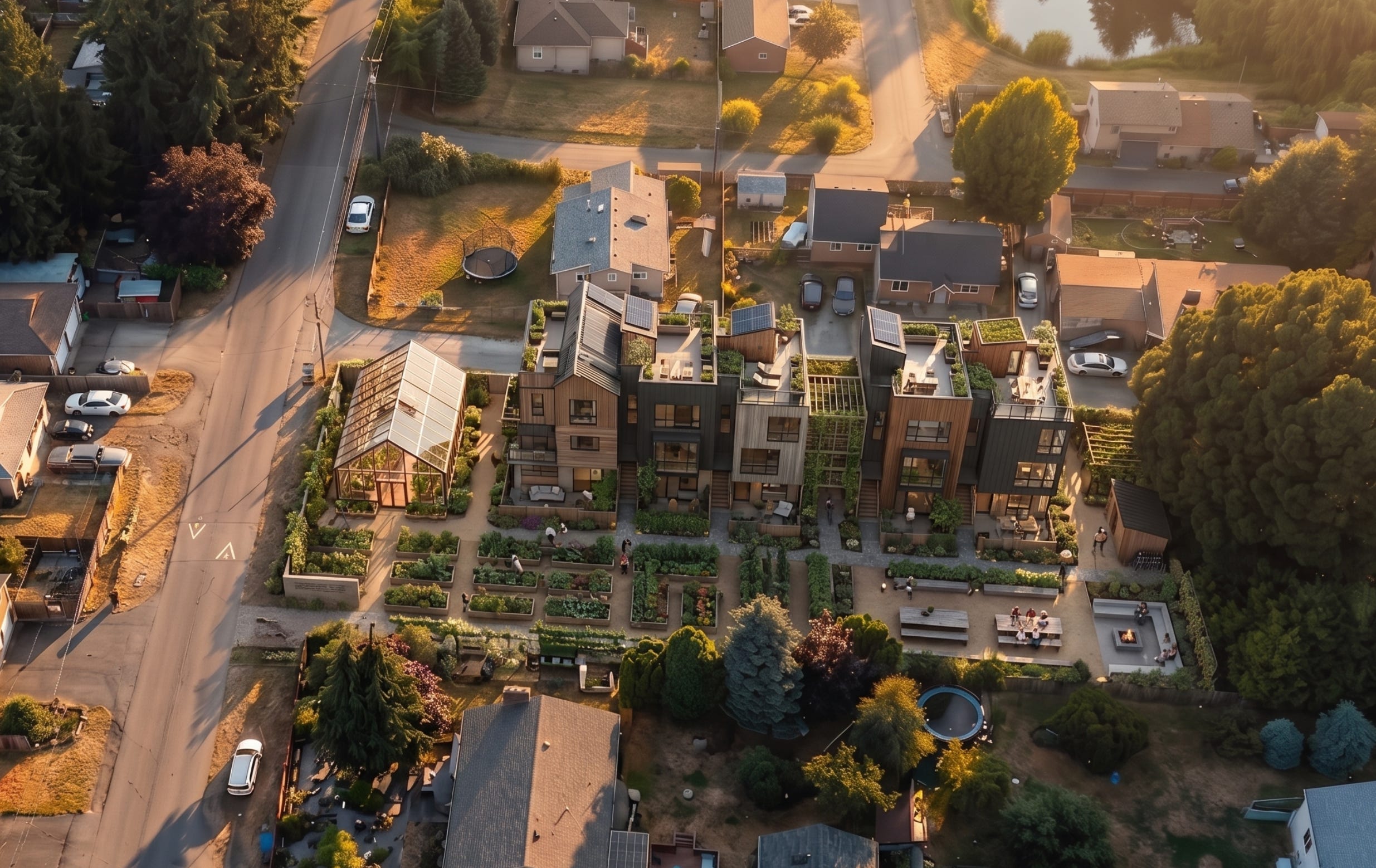
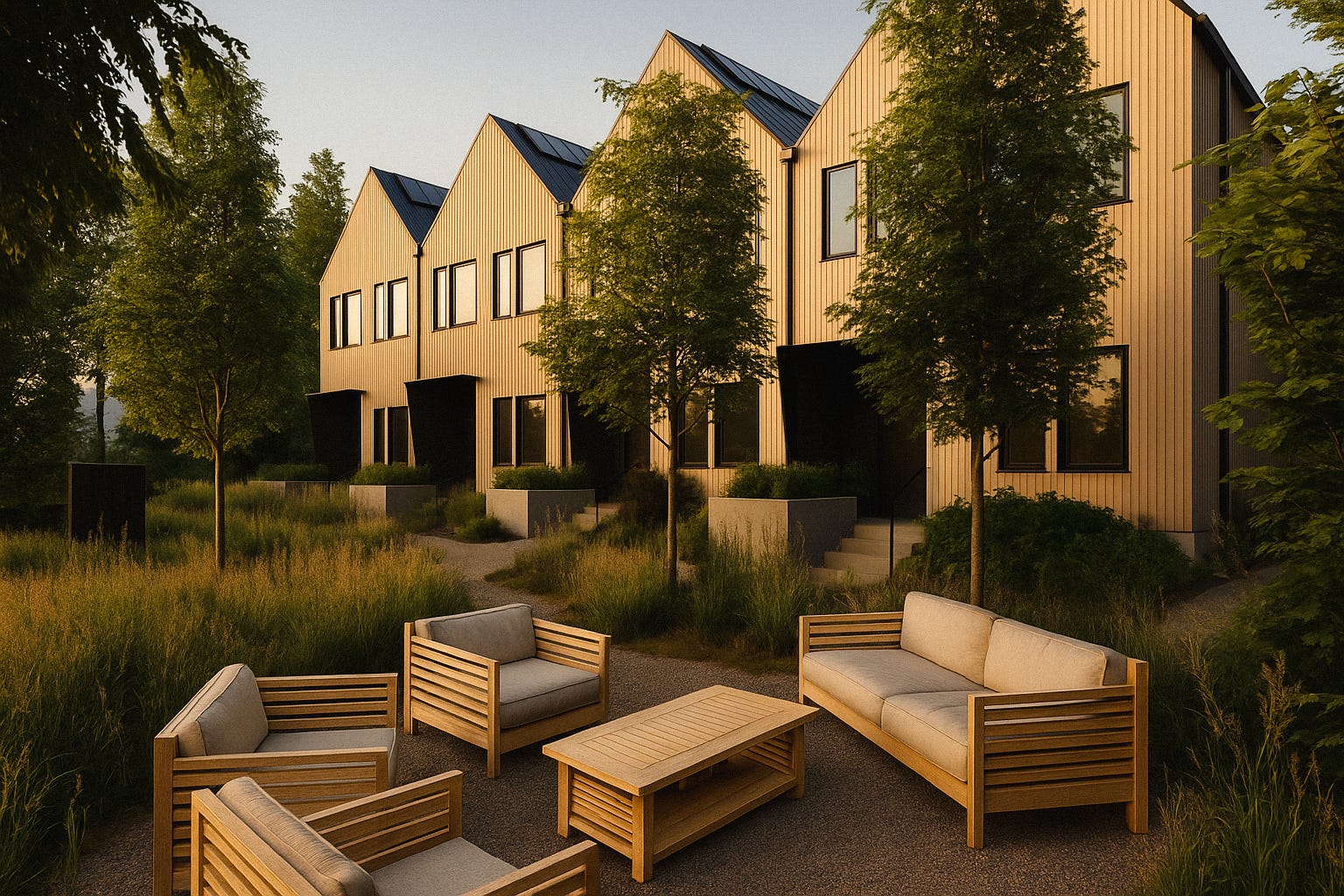
Our first project, Fieldlight Row, is taking shape now at the edge of La Conner, Washington. Four townhomes that hold the urban growth boundary rather than pushing past it into Skagit Valley’s irreplaceable farmland. Full height atriums pulling daylight deep into every level.
To those of you who supported the Holon Institute: thank you. I mean that beyond convention. And I want to be clear about something. The Holon Institute did not end. It is in hibernation, which is what living systems do when the season turns against them. They draw inward, conserve their essence, and wait for conditions to change. The Institute’s questions, its community, and its convictions are intact, and I believe its season will come. Hibernation is not death. It is fidelity to a longer rhythm.
In the meantime, your belief was not misplaced. Every question we asked together, every conversation about emergence and imagination and grief, is load-bearing in what Sysoma is becoming. The inquiry continues. It just continues in timber and soil and neighborhoods now, where I believe it can do deep work.
The world doesn’t only need better ideas about how to live. It needs places that make better living possible. That’s what I’m building now. I’d be honored to have you along. If you are an investor, land owner, or just interested in how to participate in this work, please reach out.
With gratitude,
Joel
Thinking, talking and acting like a microbiome - is complicated and perhaps UNFUNDABLE. How to generate revenue and/or resources aligned in holistic and conscious ways in living ways when “ money” is governed by 7 deadly sins - greed, vanity, etc - is a timeless endeavor.
Joel, exciting project and definitely the kind of practical dreaming we need to change the world. If you’re still looking for narrative inspiraton you might check out my little plot on substack. https://joetankersley.substack.com/p/episode-61-its-uphill-from-here